
You have an apartment. You’re glad you don’t need to mow the lawn. But you feel left out when everyone’s talking about getting solar panels because you can’t get solar for apartments.
Or can you?
We’re here to tell you that the future is here – ChatGPT can write emails better than certain coworkers you know, and it’s actually very possible to get solar panels installed in your apartment building.
Whether you live in a townhouse, a high-rise or anything in between, it’s very likely that there’s an option for you.

Apartment solar myths
Myth #1 – There’s not enough roof space so it’s not worth it.
It’s true that if you live in an apartment, you have a lower ratio of roof space available per dwelling.
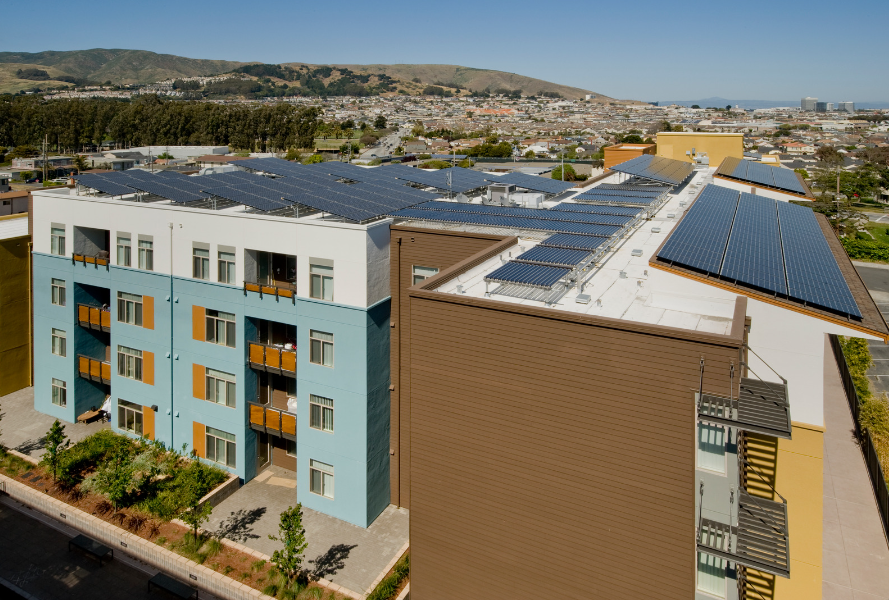
The average solar system installed in NSW is almost 10 kW (roughly 25 solar panels). In contrast, if you live in a low-mid rise apartment (1-8 storeys) and your building gets solar, your share would probably work out to about 1.5 kW (about 4 panels).
That doesn’t sound like a lot does it? Except it is, for a couple of reasons.
Apartments use less energy
Why? One simple reason is that houses are just bigger on average. Your typical 5 bedroom family home with 3 kids running around is just going to use more energy than your typical 2 bedroom apartment with a couple.
You consume more of your the electricity you generate
One basic rule when it comes to solar is that it’s always more worth it to consume the solar you generate, rather than selling it back to the grid. This is because the amount you pay for electricity form the grid (say 38c / kW) is much higher than the amount the grid pays you for excess energy you send to it (say 12c / kW)
If you live in a house, and you’re not using enough electricity during the day, you don’t really have a choice but to sell it back to the grid. However in an apartment building, the electricity you generate is much more likely to be consumed – if not by you then by your neighbour, or the common areas.
Solar is just a great investment in general
You have to remember that solar in general is a ridiculously good investment in Australia, given the rapid improvements in technology and all the sun we get.
If the amount of power generated per apartment is smaller, that also means the up-front costs per apartment are also lower.
Even if your roof isn’t the biggest roof in the world, whatever solar panels you can fit usually pay for themselves in a couple of years.
Myth #2 – You have to convince everyone in your building
If you’re already finding it hard to convince your neighbour to turn down the music, how are you going to convince them to agree to getting solar?
Luckily, you probably don’t have to.
Depending on your state, you only need 50% to 75% of the owners in the building to pass a strata resolution.
There are also options for getting apartment solar where only the owners who want solar need to pay for it. The owners who choose not to pay would then just not get the benefits.
What are your options?
Let’s walk through three examples.
Example 1: Townhouse
In a townhouse, everyone has their own roof, and there are minimal common area energy expenses.
In this situation, it usually makes sense to have a individual solar system per unit.
This means that each unit owner pays for all the costs of installing their own solar system, and receives all the benefits from that system, just like you would with a freestanding house.

Example 2: High-rise apartment
In this situation, you have:
- Small roof space relative to the number of units
- High electricity bills for common area
The right approach here is to have a single solar panel system for the building which helps offset the common area electricity usage.

You don’t need to worry about connecting up individual apartments, and it works best in larger buildings where these areas are responsible for a significant amount of energy usage.
Example 3: Mid-rise apartment
In this situation:
- It’s difficult to equitably divide roof space among individual units
- Common area electricity bills are sometimes high

A good solution here is to have a single solar system for building, but with the electricity production shared & fairly divided among units and common areas.
The piece of hardware that makes this possible is the SolShare by Allume Energy, which is offered by quality installers.
Example 4: Embedded network
Some apartment buildings are on an embedded network, which is essentially a private electricity network. The building itself has one main grid connection that is metered, while individual apartments have their own sub-meters.
In this setup, a single large solar system would be installed, and the energy would be distributed among apartments and/or common areas.
Summary of options
Now that we’ve gone through few examples, this table should make more sense.
A single strata scheme might go for multiple options if there are multiple buildings.
| Individual solar | Solar sharing | Common area Solar | |
| What is it | Individual solar system on top of each unit | Single solar system for building | Single solar system for building |
| Where solar energy is used | Individual units | Shared between individual units and common area as needed | Common areas |
| Suitable for | Townhouses and low-rise apartments | Townhouses and Low to Mid rise apartments | Mid-rise to High-rise apartments |
| Who pays for system | Individual owner | Strata committee | Strata committee |
| Who benefits | Occupants | Occupants and owners | Owners |
* Excluding embedded networks
Not sure which option is right for you?
We can help you find the right solar for your apartment block, contact us for free advice.
What are your options?
We’ll cut to the chase. Strata solar is usually worth it if it’s feasible for your building.
If you’re thinking from the perspective of the owner’s corporation, usually it’s the highest ROI thing you can do with your sinking fund.
| Individual solar | Common area Solar / Solar Sharing | |
| Cost per owner | $5000 – $10,000 | $1500 – $2500 |
| Annual savings per owner | $1000 – $2500 | $300 – $500 |
| Payback period | 3 – 5 years | 4 – 6 years |
What does the process look like?
First – a quick primer on how decision-making works in a strata scheme
- The owner’s corporation represents the interests of all the owners
- The strata manager & building manager work for the owners corporation & strata committee – they’re not in charge
- The strata committee can make some decisions on behalf of the owner’s corporation (but not all)
- This means that you can work with the strata committee to get the ball rolling, but ultimately it needs to be approved by the owner’s corporation

The whole process can take 12 months from the first conversation to installation. It’s not short, but it’s usually worth it.
Individual solar for townhouses
The process here is very similar to that of a freestanding house, except for needing approval from the owners corporation.
| Step | Approval needed | Cost | Timeframe |
| Get an estimate | None | Free | 2 minutes |
| Choose a provider | None | Free | 1 – 2 weeks |
| Talk to other owners (potential for group buy) | None | Free | 0 – 1 month |
| Pass a resolution | Owners corporation | Free | 1 – 3 months |
| Installation | $5 – $10k | 1 – 2 months | |
| Total | 2 – 5 months |
Solar for larger buildings
The main difference here is you need a feasibility & solution design report to understand the requirements of your building.
| Step | Approval needed | Cost | Timeframe |
| Get an estimate | None | Free | 2 minutes |
| Talk to other owners | None | Free | 1 – 3 months |
| Get a feasibility assessment & quotes | Strata committee | $1k – 4k | 1 – 4 weeks |
| Choose a provider | Strata committee | Free | 1 – 2 weeks |
| Pass a resolution | Owners corporation | Free | 1 – 3 months |
| Installation | $10k – 100k | 1 – 2 months | |
| Total | 4 – 9 months |
Step 1: Get an initial estimate to assess the opportunity
You want to know as quickly as possible how financially feasible solar is for your building, and how much you could save. Is solar worth considering?
It also gives you some concrete numbers that you can share with your neighbours and strata committee later.
Step 2: Talk to other owners
The next step in getting solar for apartments is to talk to other owners & involve your strata committee. Not only will they appreciate knowing that you’re looking into getting solar for the building, but they may also want to help.
Step 3: Get a solution design report
It’s great if your building is still interested in principle, but the next step is to get something more concrete, in the form of a feasibility assessment with quotes.
This will help clarify which path is most feasible and worthwhile to pursue, while considering the needs and sentiment of owners in your building.
It’s important that this report has actual quotes from installers who have visited the building, because you need something that can be approved by the wider Owner’s Corporation.
Some states have strata legislation around quotes – for example in NSW, anything over $30,000 needs 2 quotes.
Step 4: Choose a provider
Before the big vote, you want all your ducks in a row. A key decision you need to make as a strata committee is which is your preferred provider, so that this can be voted on.
Step 5: Get approval from the Owner’s Corporation
Here comes the big milestone. You will need formal signoff from the owner’s corporation to proceed.
This can take place at any of the below forums:
- Annual General Meeting
- Happens once a year
- Extraordinary General Meeting
- Can be called anytime by the owners
- Postal vote
- Some strata schemes allow these meetings to happen virtually or via a postal vote
Depending on your state you need less than 25-50% of votes cast against the resolution.
Step 6: Installation
Enjoy your savings and feel good about reducing your emissions.
Need help getting solar for your apartment?
ZapCat is a certified Social Enterprise whose mission is to make it easy to transition to clean energy.
We provide trusted advice, rigorously vet design & installation partners, and support households & strata committees end-to-end in their electrification journey.